
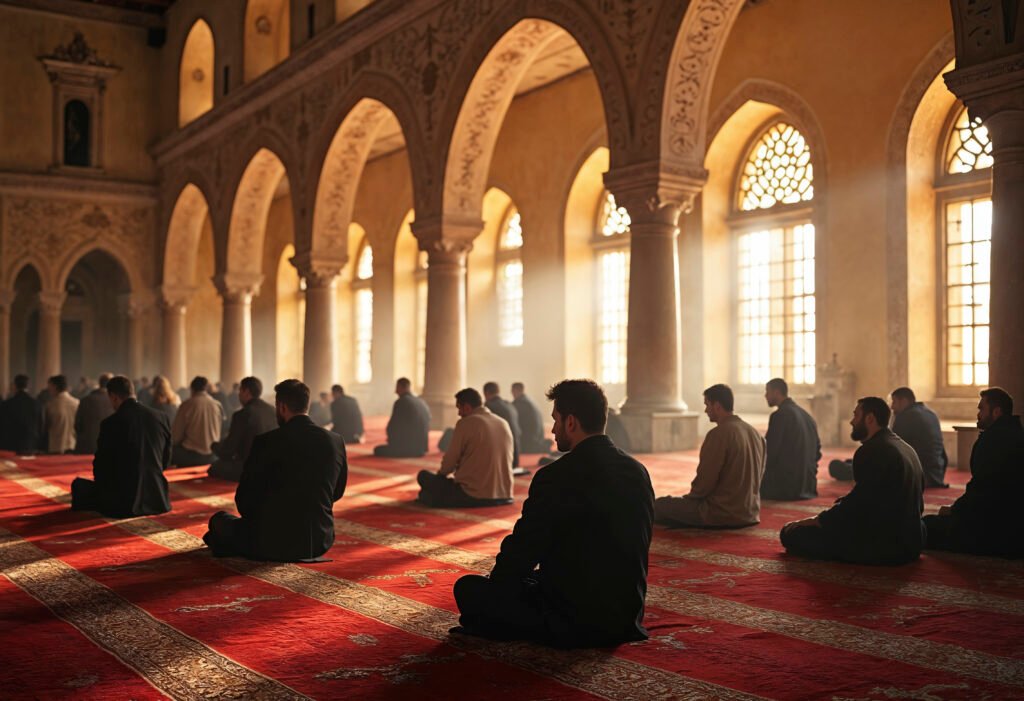
Ruling on Leaving Gaps in Prayer Due to COVID-19
By Shaykh al-Sharif Hassan ibn Ali ibn Muhammad Muntasir al-Kettani (may Allah protect him)
In the Name of Allah
All praises be to Allah, Lord of the Worlds; and may the peace and blessings of Allah be on our Prophet, Muhammad, his followers, and all his companions.
To proceed,
From the calamities which have appeared in these days, which the Muslims have been afflicted with, is the spread of the pandemic “Corona”. Doctors and specialists have advised separation of the people with a meter’s distance.
While the Masajid have opened in the majority of the lands, many have asked about the ruling on standing a distance apart during prayer. Below is an explanation.
The First Matter: Texts Related to Filling the Rows and Closing the Gaps
Filling up the rows, closing the gaps, and completing each row one by one were taught when prayer was first legislated.
Hadith of Anas
The Messenger of Allah (ﷺ) said:
❝Complete the first row, then the one behind it, and if any row is to be left incomplete let it be the last row.❞
Narrated by Ahmad, Abu Dawud, and an-Nasa’i.
From Abu Dawud:
❝Complete the front row, then the one that comes next, and if there is any incompleteness, let it be in the last row.❞
(Authenticated by al-Albani)
Hadith of Ibn Umar
The Prophet (ﷺ) said:
❝Set the rows in order, stand shoulder to shoulder, close the gaps, be pliant in the hands of your brethren, and do not leave openings for the devil. If anyone joins up a row, Allah will join him up, but if anyone breaks a row, Allah will cut him off.❞
Hadith of Anas
The Prophet (ﷺ) said:
❝Stand close together in your rows, bring them near one another, and stand neck to neck… I see the devil coming through openings in the row like a small black sheep.❞
Meaning of Coming Close and Straightening the Rows
As-Sindhi رحمه الله
On “Stand close together”: explanation of physical closeness.
An-Nawawi رحمه الله
Straightening the rows includes:
fixing each row properly
closing the gaps
standing next to each other
not stepping ahead of the person next to you
not beginning a second row before finishing the first
(Majmūʿ al-Fatāwā)
Ibn ʿAbdil-Barr رحمه الله
Fixing the rows is agreed upon
Narrations are mutawātir (mass-transmitted)
The Caliphs acted upon it
(Al-Istidhkār)
The Second Matter: Ruling on Straightening the Rows
There are two scholarly opinions:
1. Straightening the Rows Is Sunnah (Majority Opinion)
Accepted by all four madhāhib:
Hanafis – Tabayyin al-Haqā’iq, Hashiyat al-Tahtawi
Malikis – Al-Tanbīh, Al-Fawāqih ad-Dawānī
Shafiʿis – Al-Majmūʿ, Mahaj al-Qawīm
Hanbalis – Al-Insāf, Kashf al-Qināʿ
Based on narrations:
❝Straighten your rows and stand closer together, for I see you from behind my back.❞
(Bukhari & Muslim)
❝Straighten your rows, for straightening rows is essential for the perfection of prayer.❞
(Bukhari)
2. Straightening the Rows Is Obligatory
Held by:
Ibn Hazm
Ibn Taymiyyah
Ibn Hajar
Al-Qadhi Abu Bakr ibn al-ʿArabi
Based on:
❝Make your rows straight or Allah will cause discord among you.❞
(Muslim)
The Third Matter: Does Separation Invalidate the Prayer?
Scholars held two opinions:
1. The prayer is valid
This is the opinion of the majority.
2. The prayer is invalid
Attributed to:
some Hanbalis
Ibn Hazm
Ibn Muflih
Preferred Opinion (Rājiḥ): The Prayer Is Valid
All four madhāhib agree:
Straightening rows is Sunnah, not a pillar
A separation does NOT invalidate the prayer
But it is disliked (makrūh)
Ibn Hajar رحمه الله said:
Even when Anas criticized misalignment, he did not command people to repeat the prayer, showing validity.
The Fourth Matter: Ruling on Separation of the Rows Due to Fear of Disease
Allah says:
﴿فَإِنْ خِفْتُمْ فَرِجَالًا أَوْ رُكْبَانًا…﴾
(Al-Baqarah 239)
Meaning:
In cases of fear, one adapts the prayer as necessary.
Fiqh Principle
Necessity permits what is normally not allowed.
Classical Maliki References Supporting Distancing
Ibn Abi Zayd al-Qayrawani
Permitted spaced-out prayer to protect property (horses).
Imam Malik
Permitted praying under shade with distance between people when heat was severe.
Umar ibn al-Khattab
Prayed on his garment due to extreme heat.
Ibn Habib
Reported that Malik allowed a scholar to pray distantly from his students.
Action of the Salaf
Umar told Mu’iqib (who had leprosy):
❝Sit from me a limit of a spear.❞